Does a Whole House Water Filter Soften Water? The Honest Answer
Our top picks
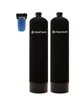 Filter + salt-free conditioner in one cabinetPelican PSE2000 Filter + Salt-Free Conditioner15 GPM · 1,324,800 gal · Third-party scale testing8.3Price tier: Flagship, over ~$2,200Check price on Amazon
Short answer: no. A standard whole house water filter does not soften water. This is the single most common point of confusion in home water treatment, and it costs people real money — they buy a $1,200 filter expecting softer-feeling showers and spot-free dishes, then learn that hardness was never on the filter’s job description.
Two problems, two kinds of equipment
Filters remove things from water. Chlorine, chloramine, sediment, lead, PFAS, VOCs, hydrogen sulfide — contaminants you don’t want to drink, breathe in the shower, or run through appliances. Media like activated carbon, KDF, and catalytic carbon adsorb or trap these.
Softeners remove hardness minerals. Calcium and magnesium — the dissolved rock that makes water “hard.” A salt-based softener swaps them for sodium via ion exchange. The minerals are physically gone from the water.
Nothing about a carbon or KDF bed removes calcium or magnesium in meaningful quantities. They’re simply different chemistries solving different problems.
How to tell which problem you have
You need filtration if: water tastes or smells of chlorine, you have sediment or discoloration, you’re concerned about lead or PFAS, or a test shows specific contaminants.
You need softening/conditioning if: white scale builds up on faucets and showerheads, dishes come out spotty, laundry feels stiff, soap doesn’t lather well, or a test shows hardness above ~7 grains per gallon.
You might need both if: you checked boxes in both lists — which is extremely common, since municipal water is often both chlorinated and moderately hard. Our how-to-choose guide starts with testing precisely so you don’t buy the wrong half of the solution.
“Salt-free softener” — what it really is
The term is marketing, not chemistry. Salt-free systems (like the conditioner stage in the Pelican PSE2000) use TAC — template-assisted crystallization — media. Here’s what actually happens: dissolved calcium and magnesium flow through catalytic beads that convert them into microscopic, non-sticky crystals. The minerals stay in the water; they just don’t form scale on pipes, heaters, and fixtures.
That’s genuinely useful — no salt bags, no brine discharge, almost no maintenance. But:
- It doesn’t remove the minerals, so a hardness test still reads hard.
- It doesn’t give you that “soft water” slippery feel.
- It won’t help with existing scale — it prevents new buildup.
If you want minerals actually gone, that’s a salt-based ion-exchange softener: resin beads swap calcium and magnesium for sodium, then regenerate with salt brine. It works, and it’s the only thing that truly “softens.” The trade-offs are salt refills, brine discharge (restricted in some municipalities), added sodium, and more maintenance.
We go deeper on this distinction in salt-free softener vs filter.
The combo question: filter, softener, or both?
Match the equipment to the test results:
- Contaminants only → a filter like the SpringWell CF1 or iSpring WGB32B is the whole answer.
- Hardness only → a softener or conditioner alone; a filter adds nothing.
- Both → filter first in the plumbing train (sediment and chlorine removal protects the softener’s resin), then the softener. Combo cabinets like the Pelican PSE2000 do both in one footprint — filter plus salt-free conditioner — which suits homes that want scale prevention without salt.
One ordering note: put filtration before any softener. Chlorine degrades softener resin over time, so stripping it first extends the softener’s life. Installers who do this daily treat it as standard practice.
The bottom line
A filter makes water cleaner. A softener makes water softer. Neither does the other’s job, and “salt-free softener” doesn’t soften at all — it conditions. Test your water, buy the equipment that matches what the test found, and if you need both, size them as a system, not two separate afterthoughts. The cost calculator can total either path over five years.
How to test your hardness (5 minutes, ~$15)
Don’t guess. A $10–$15 titration test kit from a hardware store gives you grains per gallon (gpg) — the unit everything is sized in:
- 0–3 gpg: Soft. You don’t need softening; a filter alone is the answer.
- 3–7 gpg: Moderately hard. A conditioner prevents most scale; a softener is optional depending on how much you care.
- 7+ gpg: Hard. Scale is actively forming. A salt-based softener earns its keep here; a conditioner helps but won’t fully solve it.
- 10+ gpg: Very hard. Softener territory, full stop.
Test strips are cheaper but coarse — fine for a yes/no read, not for sizing equipment. For the full picture (hardness plus iron, pH, TDS, and contaminants), a lab panel runs ~$150 and is worth it before a four-figure purchase. Our water test guide walks through both.
Salt-based vs salt-free: the full comparison
| Salt-based ion exchange | Salt-free TAC conditioner | |
|---|---|---|
| Removes hardness minerals | Yes — swaps Ca/Mg for sodium | No — converts them to non-stick crystals |
| Scale prevention | Excellent | Good (prevents new scale; doesn’t remove old) |
| “Soft” feel / soap lather | Yes | No |
| Maintenance | Salt refills, brine discharge, resin care | Almost none |
| Operating cost | Salt + water for regeneration | Media replacement every few years |
| Environmental notes | Brine discharge restricted in some areas | No discharge, no electricity |
| Best for | 7+ gpg hardness, existing scale problems | 3–7 gpg, new construction, low maintenance priority |
Installation order matters
If you’re installing both a filter and a softener/conditioner, the order in the plumbing train is: sediment pre-filter → carbon filter → softener/conditioner → house. The logic: sediment and chlorine removal first protects the softener’s resin bed (chlorine degrades resin over years), and the softener goes last so it’s working on already-cleaned water. Installers treat this sequence as standard — if a quote has them reversed, ask why.
One more practical note: softeners need a drain for regeneration and a place for the brine tank; conditioners need neither. That’s a real footprint and plumbing difference when you’re planning the install location. Factor it into your installation budget — a softener adds meaningfully to the job.
The bottom line, by test result
- Test shows contaminants, hardness under 3 gpg: filter only. Done.
- Test shows 3–7 gpg hardness, no major contaminants: conditioner, or a combo unit like the Pelican PSE2000 if you want filtration too.
- Test shows 7+ gpg: salt-based softener, plus a filter ahead of it if you also have chlorine or other contaminants.
- Test shows iron or sulfur: that’s a filtration problem (see our well water guide), not a softening problem — though iron fouls softener resin, so treat the iron first.
The test is $15. The wrong equipment is $1,500. Always in that order.
Renters and condo owners: a quick note
Everything above assumes you own the plumbing. Renters usually can’t cut into the main line — and shouldn’t. Your options: an under-sink filter for drinking water, a shower filter for chlorine, and a conversation with the landlord if the building has hard-water issues (building-wide treatment is their call and their money). Don’t install a point-of-entry system in a property you don’t own.
When in doubt, test first: fifteen dollars and five minutes beats a fifteen-hundred-dollar guess every time.
Quick recap
Filters clean; softeners soften; conditioners prevent scale without removing minerals. A standard whole-house filter will not fix hard water, and a softener will not fix contaminants. Test your water for both hardness and contaminants, then buy the equipment that matches the results — filter first in the plumbing train, softener after. Get the order and the diagnosis right and the rest is straightforward.